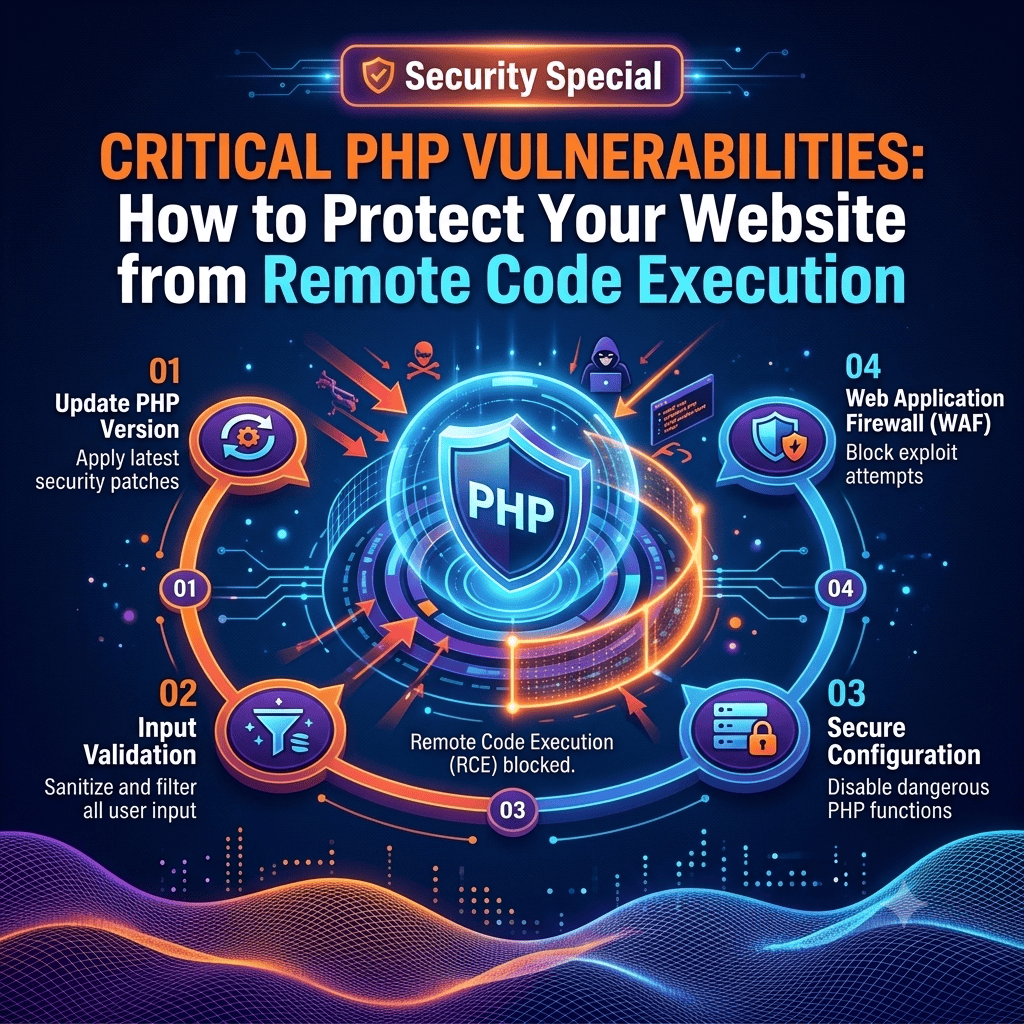
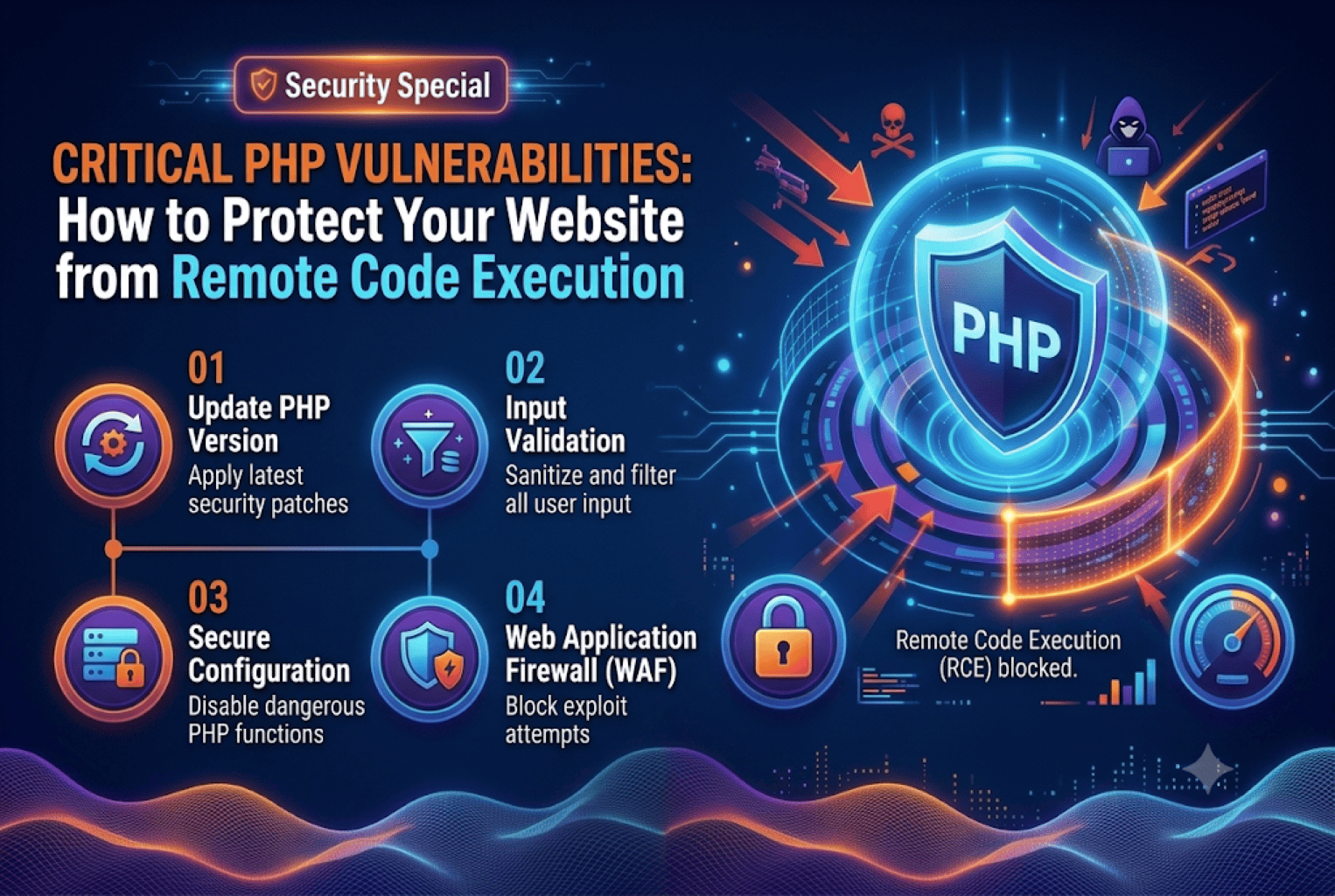
If your website, online store, or business application runs on PHP, this is one security update you cannot afford to postpone. In October, the PHP project released emergency security updates for two critical vulnerabilities in the PHP core itself. Security agencies around the world, including CISA in the United States, urged organizations to patch immediately.
PHP powers a very large share of the web, including popular platforms such as WordPress, Drupal, Joomla, and Magento, as well as countless custom business applications. That is why this issue matters to almost every company with a website. In this article, we explain what happened, who is at risk, and the exact steps to protect your business.
On October 21, the PHP developers released emergency fixes for two critical flaws in the PHP core interpreter, tracked as CVE-2026-109618 and CVE-2026-109619. Both are rated 9.2 on the CVSS v4.0 scale, which places them in the critical category.
In simple terms, these flaws can allow an attacker to run their own code on your web server. This is called remote code execution (RCE), and it is one of the most dangerous types of security problems.
Two details make the situation especially serious:
A further remote code execution issue was also reported shortly afterward, so it is wise to follow the official PHP security announcements for the latest information.
Remote code execution means a stranger on the internet can make your server run commands of their choice. If that happens, an attacker may be able to:
For a business, the results can include lost revenue, legal and compliance problems, damaged reputation, and expensive recovery work.
The PHP project has stated that every PHP installation serving web requests can be affected. This includes common setups such as:
Of these, the PHP team considers mod_php to carry the highest risk.
In practical terms, you may be affected if you have:
The emergency updates are available in the following releases:
| PHP branch | Fixed version |
|---|---|
| PHP 8.5 | 8.5.12 or later |
| PHP 8.4 | 8.4.27 or later |
| PHP 8.3 | 8.3.36 or late |
| PHP 8.2 | 8.2.35 or later |
If your site still runs an outdated version such as PHP 5.x or 7.x with no vendor support, the safest path is to upgrade to a supported version as soon as possible.
Many website owners assume that clicking “Update” in WordPress or updating their plugins solves the problem. It does not.
The vulnerabilities exist in the PHP runtime that runs on the server, not in WordPress, your theme, or your plugins. Fixing them requires updating the PHP software itself, which usually means:
Keeping your CMS and plugins updated is still important, but it is a separate task.
Security researchers warn that the time between a vulnerability becoming public and attackers using it has become very short. Automated tools and AI make it easier to scan the internet for vulnerable servers within hours. This is why waiting for the next scheduled maintenance window is risky.
The lesson is clear: when a critical, unauthenticated vulnerability is announced in software that faces the internet, patching is an emergency task, not a routine one.
Some products bundle their own copy of PHP, such as control panels, ecommerce platforms, and appliance software. Updating the PHP version on your server may not update the one inside these products. Check with each vendor for a security update, and ask your IT team to include them in your inventory.
This incident is a good reminder to improve your general security habits:
Preventing problems is almost always cheaper and easier than cleaning up after a breach.
The critical PHP vulnerabilities announced in October are a serious wake-up call for every business that runs a PHP-based website or application. They allow remote code execution without a login, they affect the PHP engine itself, and updating your CMS or plugins alone does not fix them. The only complete solution is to update PHP to a patched version and, where needed, move away from unsupported versions.
Check your PHP version today, confirm with your hosting provider, and act without delay.
Not sure whether your website is safe? Contact our team for a quick PHP security check. We will review your servers, update your PHP environment, test your applications, and help you stay protected.