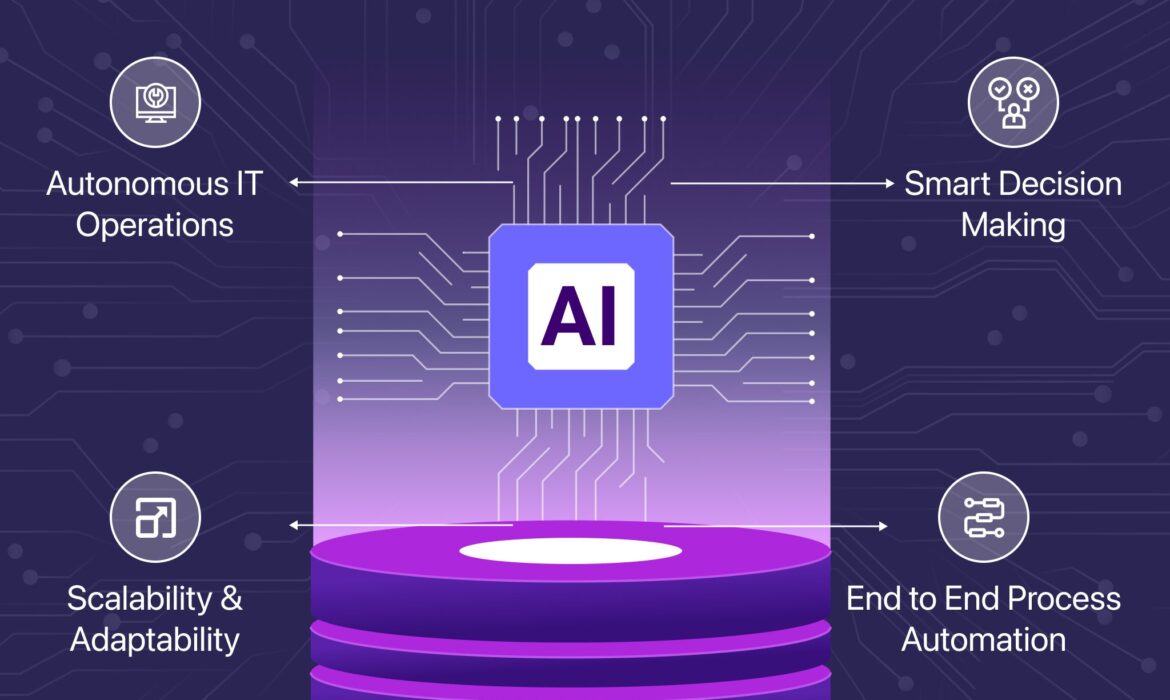
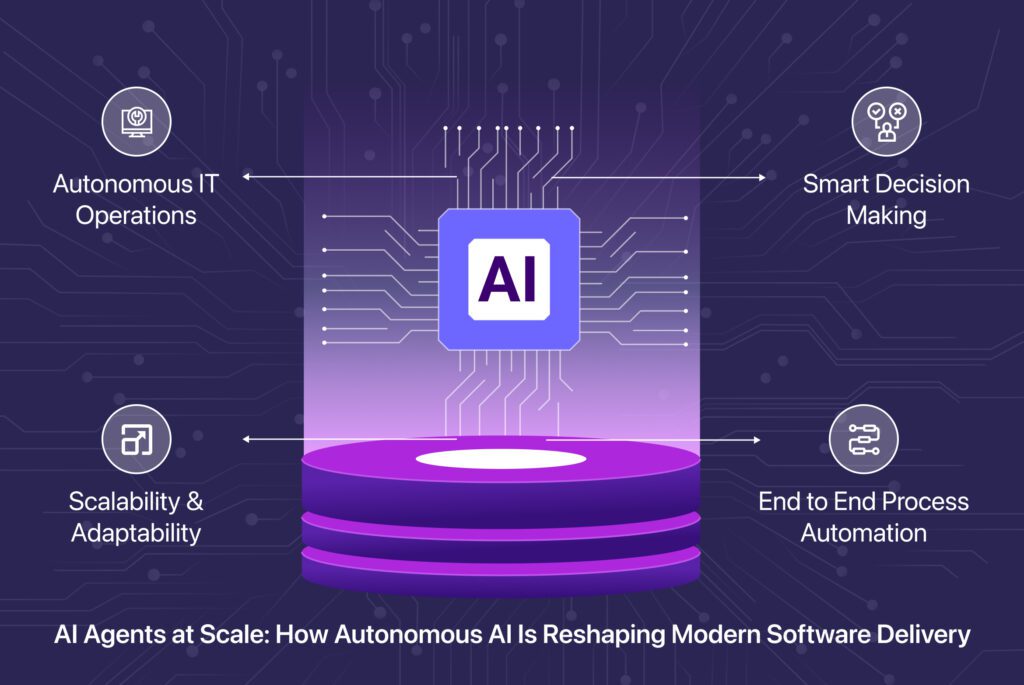
Not long ago, AI in software development meant autocomplete suggestions and basic code generation. Helpful, yes. Transformational, not quite.
Today, the conversation has shifted. Enterprises are no longer asking, “Can AI assist our developers?” They are asking, “Can AI plan, execute, and optimize workflows on its own?”
That shift marks the rise of AI agents in enterprise environments.
Autonomous AI agents are no longer experimental side projects. They are being embedded directly into product roadmaps, DevOps pipelines, analytics dashboards, and operational workflows. According to Gartner’s 2026 technology outlook, over 55 percent of enterprise software initiatives will incorporate autonomous AI workflows in some capacity.
For CTOs and product leaders, this is not just a technology trend. It is an operational shift. Development cycles are shrinking. Decision-making is accelerating. Teams are restructuring around intelligent systems.
In this blog, we break down how AI agents at scale are reshaping modern software delivery, what this means for enterprise software teams, and how HK Infosoft helps global businesses implement autonomous AI workflows safely and effectively.
An AI agent is more than a chatbot or code assistant. It is a system that can:
In enterprise environments, AI agents operate inside complex ecosystems. They interact with APIs, databases, microservices, analytics engines, and third-party platforms.
Instead of simply responding to prompts, autonomous AI workflows allow agents to complete structured tasks such as:
This evolution represents one of the most important AI software development trends 2026.
1. Reduced Development Time
Software teams often lose time on repetitive coordination tasks. AI agents reduce that friction.
Examples include:
Internal analysis across enterprise DevOps teams shows that intelligent automation can reduce sprint overhead by 20 to 35 percent.
For global clients working with HK Infosoft, we have seen development timelines shrink by integrating AI agents into CI/CD pipelines and QA processes.
2. Smarter Decision-Making Across Teams
Autonomous AI workflows analyze large datasets faster than any manual review.
In enterprise settings, this translates to:
Rather than replacing managers or architects, AI agents provide decision intelligence. CTOs gain real-time operational visibility without waiting for manual reports.
3. Scalable Workflow Automation
Traditional automation relies on fixed scripts. AI agents introduce adaptive logic.
For example:
A deployment pipeline can automatically detect patterns in past production failures and modify testing thresholds dynamically.
A customer onboarding workflow can personalize flows based on behavioral analysis instead of static forms.
This flexibility makes AI agents ideal for enterprises operating across multiple regions and compliance environments.
Autonomous systems must fit into existing infrastructure. At HK Infosoft, we design AI integration layers that align with enterprise-grade stacks including:
Key Components of AI Agents at Scale
Enterprise AI adoption succeeds when governance and control are embedded from day one.
AI-Driven DevOps Monitoring
AI agents analyze logs, detect anomalies, and trigger alerts before incidents escalate. This reduces downtime and improves system resilience.
Intelligent QA Automation
Instead of static test cases, AI generates new scenarios based on evolving user behavior.
Smart Code Review Agents
Agents evaluate pull requests for performance risks, security vulnerabilities, and architectural deviations.
Operational Analytics Agents
In SaaS and enterprise dashboards, AI agents compile executive-ready summaries automatically.
Customer Experience Automation
AI agents manage tier-one support queries and escalate complex issues intelligently.
These implementations reflect real AI agents in enterprise deployments across industries including fintech, logistics, healthcare, and SaaS.
The Developer Role Is Evolving
Developers move from writing repetitive code to supervising intelligent workflows.
CTOs Gain Strategic Visibility
Autonomous AI workflows provide predictive insights, not just historical data.
Teams Must Prioritize AI Literacy
Organizations need structured AI governance frameworks and internal training to avoid misuse.
Security and Compliance Become Critical
AI agents must operate under strict access controls and transparent logging systems.
At HK Infosoft, we implement enterprise-grade safeguards to ensure AI systems remain secure and auditable.
While the benefits are significant, scaling AI requires addressing key risks:
Our approach includes:
This ensures stable adoption rather than disruptive experimentation.
As an Ahmedabad-based IT partner serving clients across the USA, Canada, Australia, and Europe, HK Infosoft combines cost efficiency with enterprise-grade delivery.
Our AI integration methodology includes:
We specialize in AI integration IT services India, delivering scalable and secure AI-driven software systems.
Looking ahead, we expect:
The next phase of software delivery will not be human-only or AI-only. It will be collaborative.
Enterprises that adopt autonomous AI workflows early will gain speed, agility, and operational clarity.
AI agents at scale represent more than automation. They redefine how software is planned, delivered, and optimized.
For enterprises navigating complex digital ecosystems, autonomous AI workflows reduce friction, increase accuracy, and unlock new levels of efficiency.
At HK Infosoft, we help organizations move beyond experimentation toward structured, secure, and scalable AI adoption.
The AI era is not coming. It is operational.