



Many people outside QA believe software testing ends once test cases are written.
Or once automation scripts start running.
In reality, that’s only the beginning.
Because software products constantly change.
New features get added.
Old flows get modified.
UI designs change.
APIs evolve.
Business requirements shift.
And every small update can impact existing functionality.
This is where real QA work begins.
Not with writing scripts.
But with maintaining quality continuously.
At HK Infosoft, we believe long-term software quality depends more on continuous improvement than one-time testing execution.
Because stable products are built through ongoing attention, collaboration, and quality discipline.
Creating initial test cases feels productive.
Everything looks organised.
The team feels confident.
But after a few product updates, things become more complicated.
Suddenly:
This happens in almost every growing product.
Because testing is not static.
It evolves alongside the software.
At HK Infosoft, our QA teams are regularly reviewing and updating testing flows to ensure they are in sync with changing business needs and product changes.
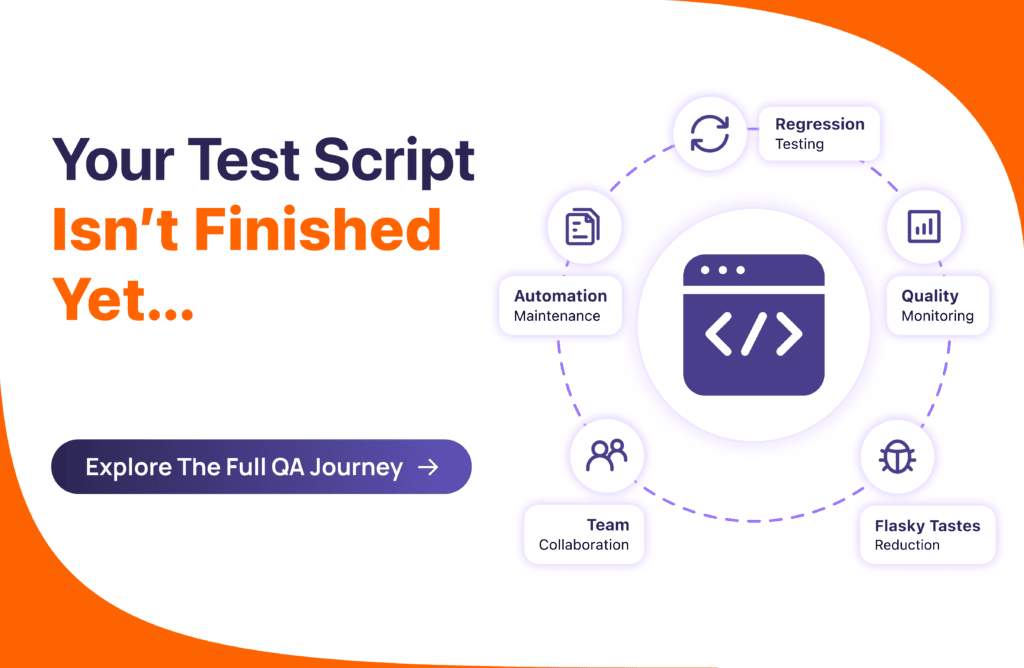
One of the biggest responsibilities of QA teams is regression testing.
Whenever new changes are introduced, teams must verify that existing functionality still works properly.
And this becomes challenging in large applications.
Imagine updating a simple login module.
That single change may unexpectedly affect:
Software systems are deeply connected.
That’s why experienced QA teams think beyond isolated features.
They think about impact.
Regression testing is essentially asking:
“What else could break because of this change?”
That mindset prevents major production issues.
HK Infosoft applies regression testing as a vital quality assurance layer prior to every major release.
Because small missed issues can have big business impact later on.
Automation maintenance is often underestimated by businesses.
They think everything becomes automated once scripts are written.
Unfortunately, that is not how real projects operate.
Multiple automation routines can be broken by a minor UI update.
Validations may be failed by an updated API response.
Entire test flows can be stopped by a revised button locator.
This results in what many QA teams refer to as:
“Maintenance burden of automation.”
Additionally, automation gradually loses dependability if teams disregard it.
People eventually lose faith in test results.
That is risky.
Because having no testing at all is worse than having false confidence.
Flaky tests are tests that sometimes pass and sometimes fail without actual product issues.
And they create serious problems.
Because teams waste time trying to understand:
“Is this a real bug… or just another unstable script?”
Over time, flaky automation creates:
Strong QA teams actively reduce flaky testing.
They stabilize environments.
They improve wait handling.
They review automation architecture.
They simplify unstable scenarios.
Quality is not only about detecting bugs.
It is also about building trust in the testing process itself.
Automation stability and flaky execution reduction are ongoing aspects of our QA improvement process at HK Infosoft.
Teams should trust test results at a confidence level during every release cycle.
In real software companies, requirements constantly evolve.
And QA teams must adapt quickly.
For example:
A booking app initially allows cancellations within 24 hours.
Later, business teams change the policy to 12 hours.
Now QA must:
Testing is deeply connected to business decisions.
That’s why good QA engineers understand product behavior – not just test execution.
At HK Infosoft our QA teams are in close communication with developers and product stakeholders to ensure that changing requirements are validated quickly and accurately.
Many release problems are not caused by technical failures.
They happen because teams misunderstand requirements.
Sometimes:
This is why communication becomes critical.
Healthy QA culture includes:
The best QA teams do not operate in isolation.
They become active contributors to product success.
We do collaboration between QA, development, and product teams is a core part of how we deliver stable and scalable software solutions.
Modern QA is continuous.
Not a single testing phase.
A healthy QA lifecycle often includes:
1. Requirement Understanding
QA reviews product expectations early.
2. Test Planning
Teams identify risks, dependencies, and priorities.
3. Test Case Creation
Manual and automation scenarios are prepared.
4. Exploratory Testing
Human creativity validates real-world usage.
5. Automation Execution
Regression coverage runs efficiently.
6. Defect Analysis
Teams investigate root causes carefully.
7. Release Validation
Smoke testing confirms production readiness.
8. Post-Release Monitoring
Teams observe real user impact after launch.
This ongoing cycle is what creates stable products.
HK Infosoft follows a structured and collaborative QA Lifecycle to ensure that the product quality is maintained throughout the development and release stages.
Mature QA teams never assume their process is perfect.
They continuously improve.
They ask:
This mindset creates long-term product quality.
And over time, it saves companies significant money.
Because preventing production problems is always cheaper than fixing business damage later.
1. Treat Testing as an Ongoing Process
Quality does not stop after release.
2. Maintain Automation Regularly
Unmaintained scripts lose value quickly.
3. Reduce Flaky Testing Aggressively
Trust in automation matters.
4. Improve Cross-Team Communication
Better collaboration creates better releases.
5. Focus on Continuous Improvement
Small process improvements create massive long-term impact.
Final Thoughts
Software quality is not created by one testing cycle.
It is built through continuous effort, collaboration, learning, and improvement.
Modern QA teams do far more than execute test cases.
They protect user experience.
They reduce business risk.
They improve release confidence.
They support development teams.
They strengthen product trust.
And most importantly:
They help companies build products people can rely on.
Because at the end of the day, quality is not a phase.
It’s a culture.
And companies that truly understand that will always build stronger products than those who treat testing as just another task.