Most systems don’t fail because of traffic.
They fail because the architecture wasn’t designed to scale with change.
What starts as a fast-moving monolith often becomes:
At some point, every growing product hits this wall.
That’s where MACH architecture enters the picture.
But here’s the problem:
Most teams jump into MACH because it’s trending—not because they understand what it actually demands.
This blog breaks it down practically:
MACH stands for:
But treating it as just a checklist is where most teams go wrong.
MACH is not a technology stack.
It’s a design philosophy for building systems that evolve without friction.
1. Microservices: Breaking the System Intentionally
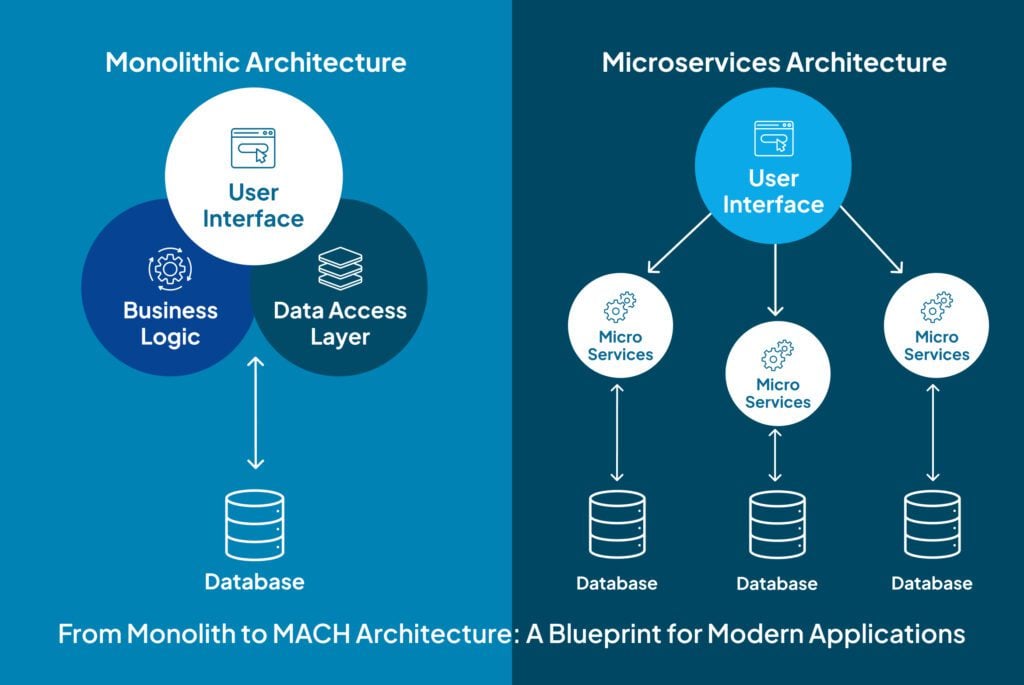
Instead of one large codebase, applications are split into independent services, each handling a specific function.
Example:
In a logistics platform:
Each service can:
2. API-First: Designing for Integration First, Not Last
Every service communicates via APIs.
This ensures:
Insight:
API-first is what makes microservices usable – not just structured.
3. Cloud-Native: Built for Elasticity, Not Just Deployment
Cloud-native isn’t just “hosted on AWS.”
It means:
Real-world benefit:
Your system handles peak demand without over-provisioning resources.
4. Headless: Decoupling Frontend from Backend
The frontend (web, mobile, dashboards) is completely independent of backend logic.
Example:
The same backend can power:
The Monolith Reality Check
Monoliths work well in early stages because:
But as systems grow:
MACH Solves This by Design
| Problem in Monolith | MACH Approach |
|---|---|
| Tight coupling | Decoupled services |
| Slow releases | Independent deployments |
| Limited scalability | Service-level scaling |
| Risky changes | Isolated update |
Not every product needs MACH.
Go for MACH when:
Avoid MACH when:
👉 Insight:
MACH is a scaling strategy – not a starting point.
1. Over-Engineering Too Early
Breaking everything into microservices from day one leads to unnecessary complexity.
2. Poor Service Boundaries
If services are not well-defined, you end up with:
3. API Chaos
Without strong API governance:
4. Ignoring Observability
Distributed systems fail silently without:
Step 1: Start with Domain-Driven Design (DDD
Define clear service boundaries based on business domains.
Example:
Instead of:
Define:
Step 2: Build API Contracts First
Before writing code:
Step 3: Containerise Everything
Use containers to:
Step 4: Implement Centralised Observability
Must-have:
Step 5: Design for Failure
Assume services will fail.
Implement:
At HK Infosoft, MACH isn’t applied blindly – it’s used where it actually creates impact.
1. Logistics & Real-Time Platforms (Like Dropit)
Challenge:
MACH Approach:
Outcome:
2. API-Driven Enterprise Systems
Challenge:
Multiple integrations (payments, CRMs, external platforms)
MACH Solution:
Outcome:
3. Scalable SaaS Platforms
Challenge:
Handling multiple clients with varying requirements
MACH Approach:
Outcome:
You’re on the right track if:
1. Platform Engineering
Internal platforms will simplify MACH complexity for teams.
2. AI-Assisted Architecture Decisions
Systems will recommend optimal service boundaries and scaling strategies.
3. Event-Driven Architectures
More systems will move toward async communication (Kafka, queues).
MACH architecture isn’t about replacing monoliths.
It’s about building systems that don’t slow you down as you grow.
The real value lies in:
But only when implemented with clarity – not hype.